Agent Skills For Context Engineering
Agent skills for context engineering help an AI agent see a small set of useful facts at the right time, rather than a pile of everything. Some skills load only when a task needs them, and some teach the agent how to manage its own context.
What Is Context Engineering?
Context engineering is the work of choosing what goes into a model's context window. That covers the system prompt, tool definitions, files, chat history and tool output.
Anthropic describes the goal as the smallest possible set of high-signal tokens that make a good result likely. Their post on effective context engineering for AI agents explains why.
Models have a limited attention budget. More text can make answers worse, not better.
Why Do Skills Help With Context?
Skills are built for it. An agent sees only each skill's name and short description at first. The full instructions load when a task needs them. RAG works another way, since it searches a knowledge base and adds the matches to your prompt, and our skills and RAG guide compares the two.
This is called progressive disclosure. A team can install many skills without filling the window, since unused ones cost only a line or two. Our guide to what agent skills are covers the SKILL.md format. Each skill costs about 100 tokens until it is used, and our guide to the three loading levels shows the rest.
The second way is more direct. Some skills teach the agent context habits, such as what to read first, what to trim and when to start fresh.
What Is In Muratcan Koylan's Collection?
Muratcan Koylan's collection on GitHub shares this topic's name, and it is MIT licensed.
Its skills are grouped by layer. Foundational ones cover the basics, like context-fundamentals, context-degradation and context-compression. Others cover design choices, such as multi-agent-patterns, memory-systems, tool-design and filesystem-context.
It reads like a course on how agents use context. If you want skills that act inside your daily coding work, the next sections cover ones you can install from the SkillTrove catalog.
Which Skills Help An Agent Manage Its Own Context?
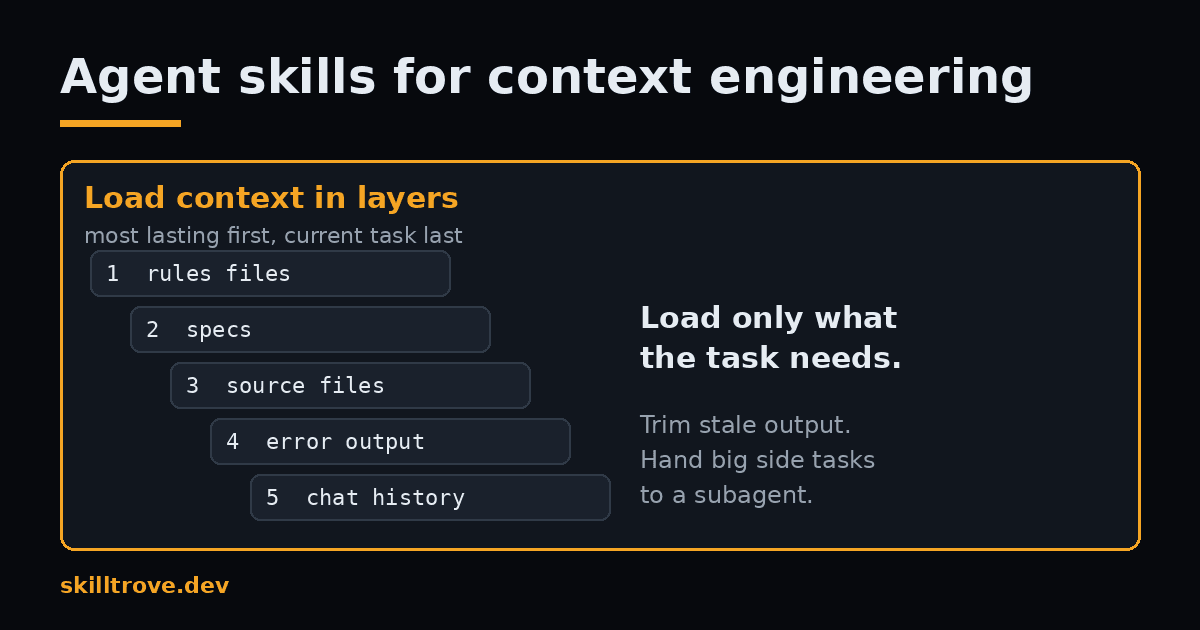
Start with the context-engineering skill by Addy Osmani. It sets up context in five levels, from most lasting to most short-lived:
- Rules files, like CLAUDE.md
- Spec and architecture docs
- The source files for the task
- Error output and test results
- Conversation history
The skill gives clear habits for each level:
- Load only the spec section you need.
- Read the file and its tests before an edit.
- Paste the one failing error, not 500 lines of output.
It also covers budgets. It says to start trimming at 75% of the window, not 100%.
It cuts failed attempts and long tool output first. It keeps the task, the current error and the file being edited until the end.
Which Skills Build Context Before The Real Work Starts?
Trail of Bits uses this idea for security work. Its audit-context-building skill maps a codebase before anyone hunts for bugs.
It records what each function assumes, what it guarantees and what it depends on. It does not name bugs or suggest fixes. That comes in the next phase, with the whole picture in hand.
How Do Skills Handle Memory As Context Grows?
Memory is context that lasts across sessions. If nothing ever leaves it, it grows stale and noisy. In Claude Code, CLAUDE.md and auto memory load at the start of every session, and our skills and memory guide compares that with a skill.
The memory-engineering skill by Alireza Rezvani treats forgetting as part of the design. It sorts records into facts, skills and logs. It refuses a memory design that has no rule for what gets removed.
Use it when a memory folder or a long CLAUDE.md keeps growing and nobody decides what goes.
How Do Subagents Fit In?
A subagent is the strongest tool for keeping a main chat clean. It works in its own context window and sends back only a summary.
The dispatching-parallel-agents skill by Jesse Vincent shows the method. You write each helper exactly the context it needs. It never inherits your whole session, and your own window stays free for coordination.
For the full trade-off, read our guide on Claude agents vs skills.
Where Should I Start?
Start with Addy Osmani's skill, since it puts the habits above in one place. Install it, then watch what your agent reads before it edits.
View the context-engineering skill by Addy Osmani
FAQ
What Is The Difference Between Prompt Engineering And Context Engineering?
Prompt engineering focuses on writing good instructions. Context engineering looks at everything the model sees, including tool output, files, memory and past messages.
A great prompt can still fail if it sits under thousands of lines of stale logs. Context engineering manages that whole window over a long task, not just one message.
Is CLAUDE.md Part Of Context Engineering?
Yes. CLAUDE.md is the top layer of context in Claude Code, because it loads in every session.
Keep it short and limited to facts every task needs. Move long procedures and reference docs into skills, so they load only when the work calls for them.